
Exponential Moving Average Mistakes Traders Should Avoid
The Exponential Moving Average, better known as the EMA, is one of the most used indicators in trading. Forex traders, stock traders, and crypto traders all use it to spot trends, find entries, and manage trades.
The reason traders like EMAs is simple. They react faster to price movement than simple moving averages. That makes them useful during strong trends and fast-moving markets.
But faster does not always mean better.
A lot of traders misuse EMAs and end up taking poor trades because they trust the indicator too much. The EMA is a tool, not a prediction machine. It follows price. It does not lead it.
Many beginners lose money because they treat EMA crossovers as automatic buy and sell signals. Others clutter their charts with too many moving averages and end up confused instead of confident. This becomes even more important in fast-moving forex markets where tight spreads and quick execution can affect overall trade management.
That is one reason many active traders use Dominion Markets for its raw spreads and tight 0.1 pips during volatile sessions.
Understanding the most common EMA mistakes can help traders avoid unnecessary losses and make better decisions.
Ready to Apply This in Live Markets?
Treating the EMA Like a Predictive Indicator
One of the biggest mistakes traders make is believing the EMA predicts the future.
It does not.
The EMA is based on past price data. Even though it reacts faster than an SMA, it still lags behind the market.
This is the basic EMA formula traders rely on:
EMA_t = (P_t × k) + EMA_{t-1} × (1-k)
The indicator simply gives more weight to recent prices. That makes it more responsive, but it still reacts after price has already moved.
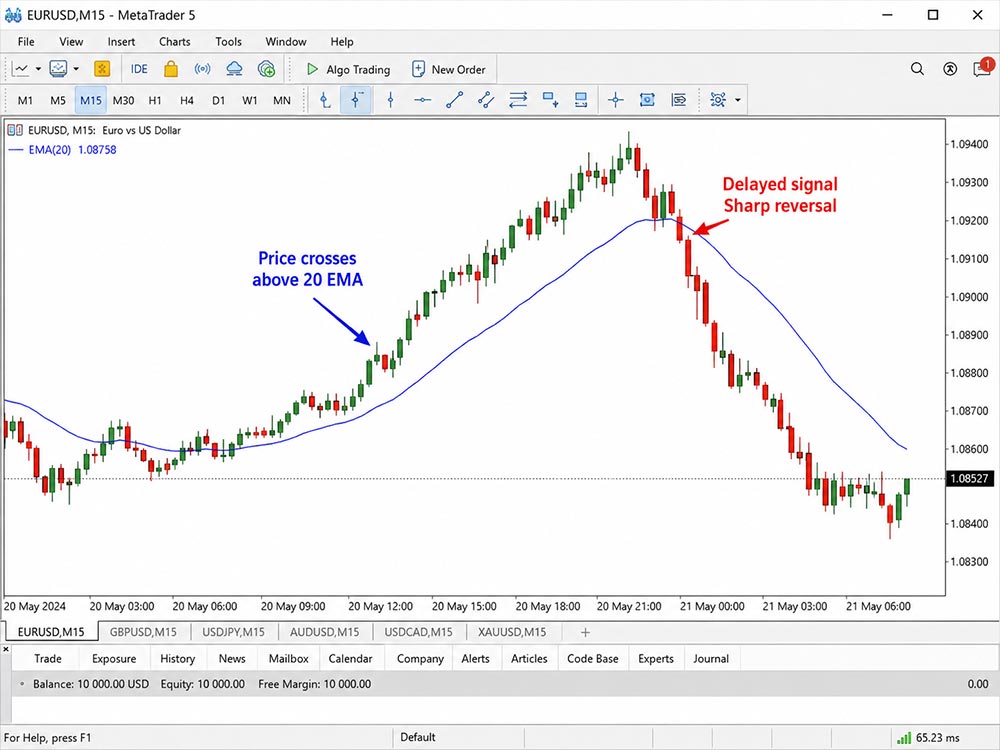
A trader sees price crossing above the 20 EMA and enters long. A few candles later, the market reverses sharply. The trader then realizes the signal came too late.
This happens often because traders forget that EMAs follow price action rather than predict it.
The EMA should support your analysis, not replace it.
Trend-following traders often use EMAs to stay aligned with market momentum rather than chasing late entries. This detailed guide on Exponential Moving Average trend trading explains how traders apply EMA setups during continuation moves in forex markets.
Treating the EMA Like a Predictive Indicator
Using EMA Crossovers Alone
Many traders build their entire strategy around EMA crossovers.
For example:
- 9 EMA crossing above 21 EMA = buy
- 9 EMA crossing below 21 EMA = sell
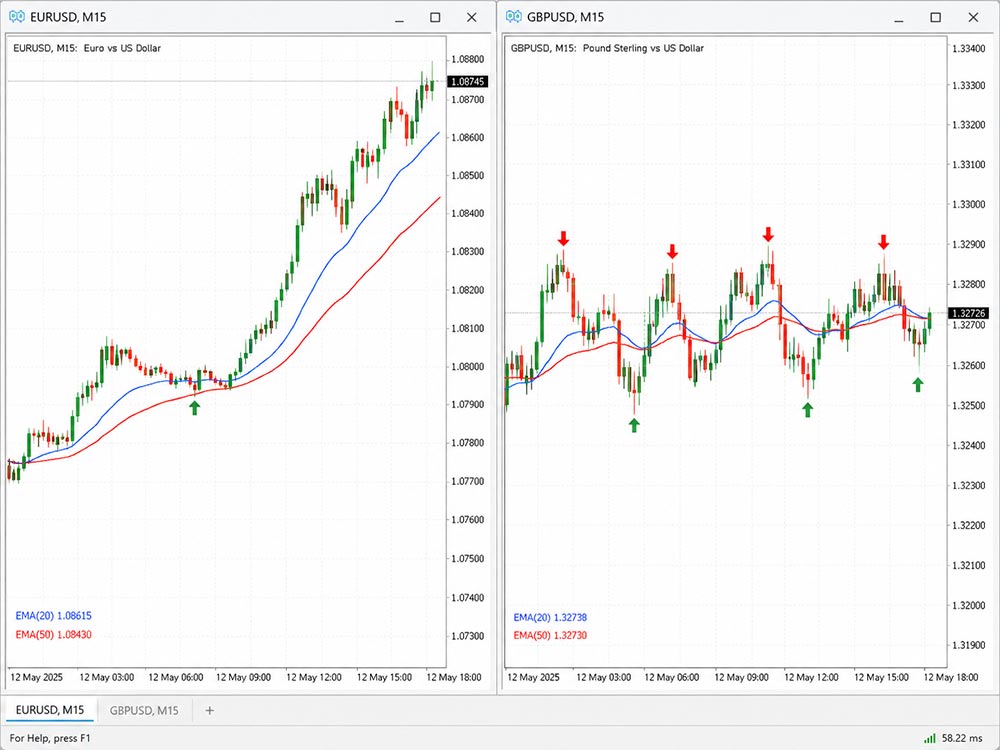
The problem is that markets are not always trending.
During sideways conditions, crossovers become unreliable. Price keeps moving above and below the EMAs, creating false entries. This is called a whipsaw market.
Traders often lose several trades in a row because they keep reacting to every crossover signal.
The mistake is not the EMA itself. The mistake is using it without confirmation.
Professional traders usually combine EMAs with:
- support and resistance,
- candlestick patterns,
- RSI,
- market structure,
- higher timeframe direction,
- volume analysis.
A crossover inside a strong trend is very different from a crossover in a ranging market.
Using EMA Crossovers Alone
Choosing the Wrong EMA Length
Another common mistake is using the wrong EMA setting for the market or trading style.
Short EMAs react quickly but create more noise. Long EMAs are smoother but slower.
This weighting factor explains why shorter EMAs react faster:
k = 2 / (n + 1)
Smaller periods increase sensitivity. Larger periods reduce sensitivity.
A 9 EMA on a 1-minute chart behaves very differently from a 200 EMA on a daily chart.
Some traders copy EMA settings from social media without understanding why those settings are used. What works for a scalper may not work for a swing trader.
Short-term traders often use:
- 9 EMA,
- 20 EMA,
- 21 EMA.
Longer-term traders may prefer:
- 50 EMA,
- 100 EMA,
- 200 EMA.
The key is matching the EMA to your trading style and timeframe.
Fast intraday sessions usually require quicker reactions and tighter confirmation signals. Traders using Exponential Moving Average intraday trading strategies often depend on lower timeframe EMA movement to capture short-term momentum shifts.
Choosing the Wrong EMA Length
Ignoring Market Conditions
EMAs perform best during clear trends.
They perform much worse during choppy or highly volatile conditions.
This is where many traders struggle.
A strong trending market can make EMAs look almost perfect. Traders then become overconfident and continue using the same approach during consolidation periods.
That usually leads to repeated losses.
For example, during major news events, price may spike rapidly in both directions. EMAs struggle to handle that type of volatility because they constantly react to sudden price swings.
This creates fake signals and emotional trading.
Before trusting an EMA setup, traders should first ask:
- Is the market trending?
- Is price ranging?
- Is volatility unusually high?
- Is there major news coming?
The EMA works best when combined with broader market context.
EMA strategies are widely used across forex markets because they help traders track momentum and trend direction more clearly. This guide to Exponential Moving Average for forex trading breaks down how traders apply EMAs in different market conditions.
Ready to Apply This in Live Markets?
Using Too Many Moving Averages
Some traders overload their charts with indicators.
You may see charts using:
- 9 EMA,
- 20 EMA,
- 21 EMA,
- 50 EMA,
- 100 EMA,
- 200 EMA,
- plus several other indicators.
At that point, the chart becomes messy and difficult to read.
More indicators do not always improve analysis.
Too many moving averages often create conflicting signals. One EMA may show bullish momentum while another suggests weakness.
This causes hesitation and poor decision-making.
Most experienced traders keep things simple. They focus on a few key levels and use moving averages as guides rather than absolute rules.
Clean charts usually lead to clearer decisions.
Trading Every EMA Touch
Another major mistake is assuming every pullback into the EMA is a trading opportunity.
Price touching the EMA does not automatically mean the trend will continue.
Many traders enter trades too early because they assume the EMA will always act as support or resistance.
Sometimes the trend is already weakening. Other times the market is preparing for a reversal.
Instead of entering immediately, traders should look for confirmation:
- rejection candles,
- bullish or bearish engulfing patterns,
- strong volume,
- break of market structure.
The EMA works better as an area of interest rather than an exact entry signal.
Lower timeframe setups can become risky when traders rush entries without confirmation. Many traders using an Exponential Moving Average scalping strategy wait for additional confirmation signals to avoid fake breakouts and sudden reversals.
Ignoring Higher Timeframes
A trader may see a bullish EMA crossover on the 5-minute chart and enter long without checking the higher timeframe.
Meanwhile, the 4-hour chart may still be strongly bearish.
This creates conflict.
Lower timeframe signals are weaker when they go against the larger trend.
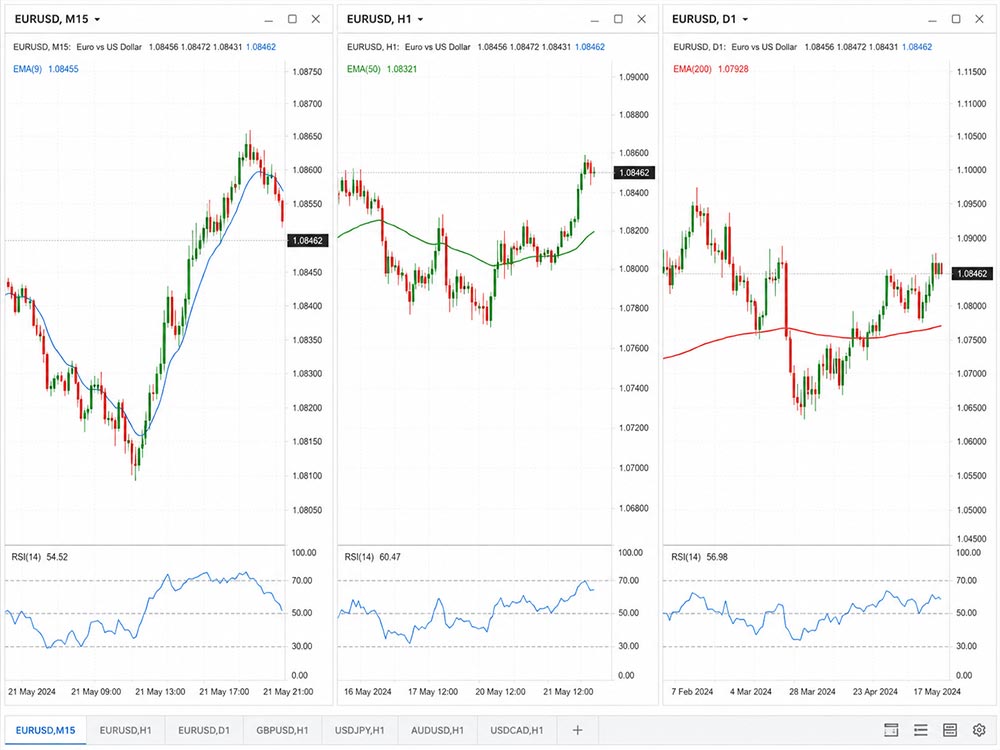
Professional traders often use multiple timeframe analysis. They use higher timeframes to identify trend direction and lower timeframes for entries.
For example:
- daily chart shows bullish structure,
- 4-hour chart confirms momentum,
- 15-minute chart provides the entry.
This approach helps filter weak EMA signals
Over-Optimizing EMA Strategies
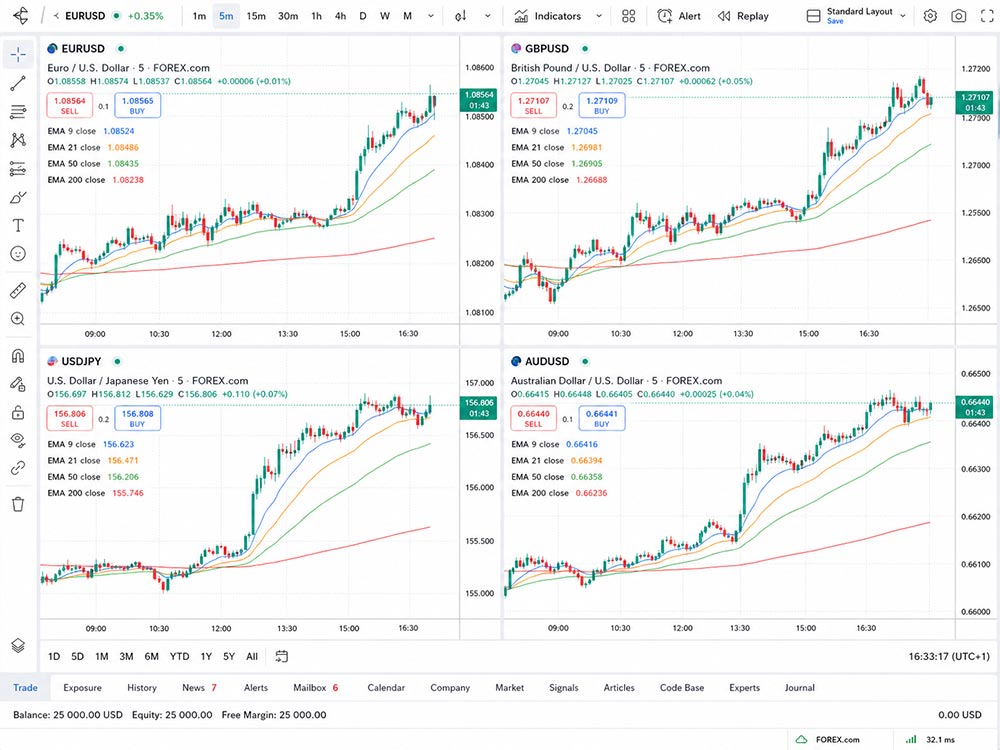
A lot of traders spend hours testing different EMA combinations:
- 8 and 21,
- 9 and 20,
- 10 and 30,
- 13 and 50.
They keep adjusting settings until the strategy looks perfect on past data.
This is called over-optimization.
The problem is that markets constantly change. A setup that worked well during one market phase may fail completely later.
Traders then become frustrated because the strategy stops performing in live conditions.
There is no magical EMA setting that works forever.
Consistency usually comes from:
- risk management,
- patience,
- discipline,
- understanding market structure.
The EMA is only one part of the process.
Over-Optimizing EMA Strategies
Letting EMAs Replace Risk Management
Some traders believe the EMA itself protects them from bad trades.
It does not.
Even strong EMA setups can fail.
Without proper stop-loss placement and position sizing, traders can take heavy losses from a single reversal.
Risk management matters more than any indicator.
A good trader can survive a losing streak because they protect their capital. A reckless trader can destroy an account even with a decent strategy.
This is one reason many traders prefer trading with firms like Dominion Markets, where fast execution, raw spreads, and reliable trading conditions help traders manage entries and exits more effectively during volatile market moves.
Ready to Apply This in Live Markets?
Final Thoughts
The EMA is a useful tool when used correctly. It can help traders spot trends, manage pullbacks, and improve timing.
But many traders misuse it.
The biggest EMA mistakes usually come from:
- overtrusting crossovers,
- ignoring market conditions,
- using the wrong timeframe,
- trading without confirmation,
- abandoning risk management.
The EMA should support price action analysis, not replace it.
Traders who understand the strengths and weaknesses of moving averages usually make calmer and more disciplined decisions. Over time, that matters far more than finding the “perfect” EMA setting.
This is why many traders prefer brokers like Dominion Markets, known for raw spreads, 0.1 pips, and fast execution speeds that can help reduce unnecessary slippage when trading EMA-based setups.
FAQs
1. Is EMA better than SMA?
Not always. EMA reacts faster to price movement, while SMA is smoother and slower. EMA works well in trending markets, but it can create more false signals during consolidation.
2. Which EMA is best for trading?
There is no single best EMA. Short-term traders often use the 9 EMA or 20 EMA, while swing traders may prefer the 50 EMA or 200 EMA.
3. Why do EMA crossovers fail?
Crossovers often fail in sideways markets where price keeps moving above and below the moving averages. This creates false signals called whipsaws.
4. Should traders use EMA alone?
No. EMAs work better when combined with price action, support and resistance, candlestick analysis, and risk management.
Ready to Apply This in Live Markets?


