

Exponential Moving Average Strategy for Forex Trading
The exponential moving average, or EMA, is one of the most used tools in forex trading. It helps you read the trend and time your entries with more clarity. Many traders use it daily because it is simple, fast, and easy to apply.
This guide breaks down how EMA works and how to build a solid trading strategy around it.
What Is the Exponential Moving Average
The EMA is a type of moving average that gives more weight to recent prices. This makes it react faster than a simple moving average.
Instead of treating all price data the same, the EMA focuses more on the latest candles. This helps you spot trend changes earlier.
In forex, timing matters. A faster signal can make a big difference in your entries and exits.
Why Traders Use EMA in Forex
The EMA helps with three main things:
- Spotting the trend
- Finding entry points
- Managing trades
It removes some of the noise from price charts. This makes it easier to see where the market is heading.
Traders like it because it works across all timeframes. You can use it for scalping, intraday trading, or swing trades.
Understanding Trend with EMA
The first use of EMA is simple. It helps you read the direction of the market.
- Price above EMA = uptrend
- Price below EMA = downtrend
This rule keeps you trading with the trend. It stops you from taking trades against market flow.
If price keeps bouncing above the EMA, buyers are in control. If it stays below, sellers are in control.
Ready to Apply This in Live Markets?
EMA Crossover Strategy

EMA Crossover Strategy
The most common EMA strategy is the crossover method. It uses two EMAs:
- A fast EMA (short period)
- A slow EMA (long period)
The idea is simple. When the fast EMA crosses the slow EMA, momentum shifts.
Buy Signal
- Fast EMA crosses above slow EMA
- This shows rising momentum
Sell Signal
- Fast EMA crosses below slow EMA
- This shows falling momentum
This setup works best in trending markets. It helps you catch the start of a move.
Traders who want a deeper breakdown of fast EMA signals often use the 9 and 21 Exponential Moving Average Strategy to refine entries and timing.
Common EMA Settings
There is no single best setting. Still, traders often use these:
- 9 EMA and 21 EMA for short-term trades
- 20 EMA and 50 EMA for intraday setups
- 50 EMA and 200 EMA for long-term trends
Short EMAs react faster but give more false signals. Long EMAs are slower but more stable.
Choose settings based on your trading style.
For traders focused on stronger trends, the 50 Exponential Moving Average Strategy for Trend Trading offers a more stable approach with fewer false signals.
Ready to Apply This in Live Markets?
Using EMA as Dynamic Support and Resistance
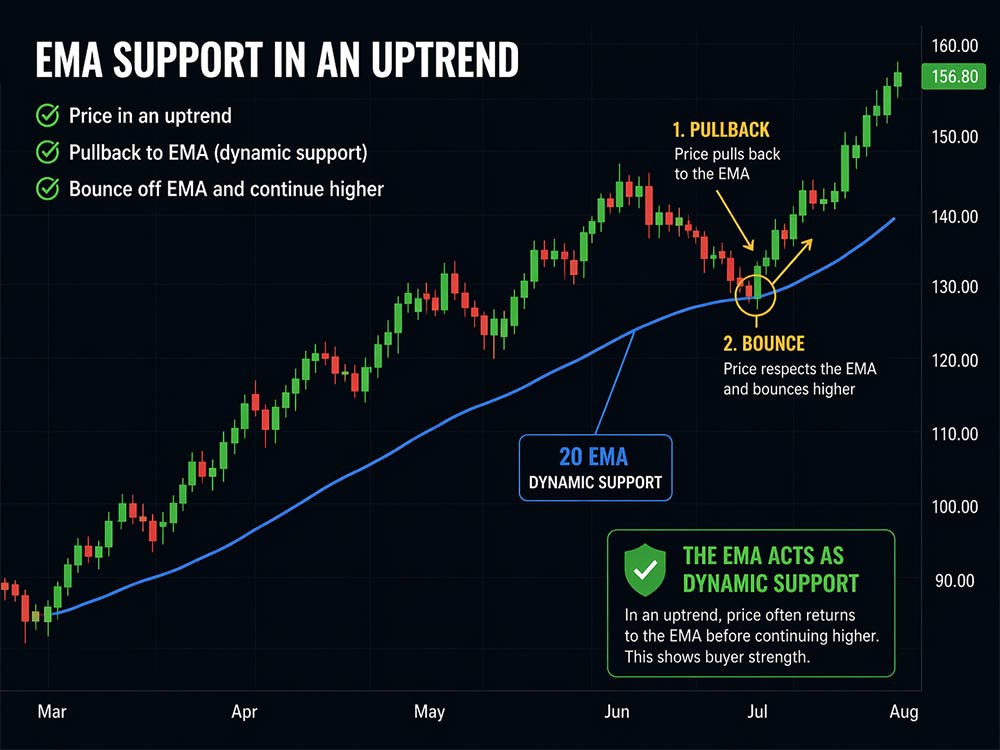
Using EMA as Dynamic Support and Resistance
EMA is not only for trend direction. It also acts like a moving support or resistance level.
In an uptrend:
- Price pulls back to EMA
- Then continues higher
In a downtrend:
- Price moves up to EMA
- Then drops again
This gives you clean entry zones. Instead of chasing price, you wait for pullbacks.
Simple EMA Forex Strategy

Simple EMA Forex Strategy
Here is a basic strategy you can start with.
Setup
- Add 9 EMA and 50 EMA to your chart
Buy Rules
- 9 EMA crosses above 50 EMA
- Price stays above both EMAs
- Enter on a small pullback
Sell Rules
- 9 EMA crosses below 50 EMA
- Price stays below both EMAs
- Enter on a small retrace
Exit Rules
- Close when EMAs cross again
- Or when price breaks the trend
This method keeps things simple. It avoids overthinking.
You can also combine this with momentum tools, as shown in the Exponential Moving Average and RSI Trading Strategy or the Exponential Moving Average and MACD Strategy, to improve confirmation.
Improving the Strategy with Confirmation
EMA works better when combined with other signals.
You can add:
- Support and resistance levels
- Trendlines
- RSI for momentum
- Candlestick patterns
For example, if EMA shows a buy signal near support, the trade becomes stronger.
Do not rely on EMA alone in choppy markets.
Ready to Apply This in Live Markets?
Best Timeframes for EMA Trading
EMA works on all timeframes, but results vary.
- 1M to 5M → fast trades, more noise
- 15M to 1H → balanced setups
- 4H to Daily → stronger trends
If you are new, stick to 15M or 1H charts. They offer a good mix of speed and reliability.
Risk Management with EMA
No strategy works all the time. Risk control is key.
Always:
- Use stop loss on every trade
- Risk a small part of your account
- Avoid overtrading
A common approach:
- Place stop loss below recent swing low for buys
- Above swing high for sells
Keep your risk consistent. This protects your capital over time.
Common Mistakes to Avoid
Many traders misuse EMA. Here are the common errors:
Trading in Sideways Markets
EMA gives false signals when price moves in a range. Avoid trading when the market lacks direction.
Using Too Many Indicators
Keep your chart clean. Too many tools create confusion.
Entering Late
If the crossover happens far from the EMA, the move may be over.
Ignoring Market Context
Always check the bigger trend. Do not rely on one signal.
When EMA Works Best
EMA performs best in trending markets. It helps you stay in trades longer and ride the move.
It struggles in choppy conditions. Price keeps crossing the EMA without clear direction.
A simple filter:
- Trade only when EMAs are clearly sloped
- Avoid flat or sideways lines
Advanced EMA Idea: Multi-EMA Setup

Advanced EMA Idea: Multi-EMA Setup
Some traders use three EMAs:
- 9 EMA (fast)
- 21 EMA (medium)
- 50 EMA (slow)
When all three line up:
- Uptrend → 9 above 21, 21 above 50
- Downtrend → 9 below 21, 21 below 50
This confirms a strong trend structure.
For long-term bias and key reaction zones, many traders rely on the 200 Exponential Moving Average to guide higher timeframe decisions.
Ready to Apply This in Live Markets?
Final Thoughts
The EMA strategy is simple but powerful. It helps you follow the trend and avoid random trades. Many traders apply this approach with the best forex brokers like Dominion Markets, known as a strong forex broker for fast execution and tight spreads.
Start with basic crossover rules. Then improve your entries with support, resistance, and price action.
Do not rush into trades. Wait for clean setups.
With time, EMA can become a core part of your forex trading system.
FAQs: EMA for forex trading
1. What is the best EMA for forex trading?
There is no single best EMA. Many traders use 9, 21, 50, and 200 periods based on their style.
2. Is EMA better than SMA?
EMA reacts faster to price changes. This makes it better for short-term trading.
3. Can beginners use EMA strategy?
Yes. EMA is simple and easy to understand. It is a good starting point.
4. Does EMA work in all market conditions?
No. It works best in trending markets. It gives weak signals in sideways conditions.
5. Should I use EMA alone?
No. Combine it with other tools like support, resistance, or momentum indicators for better results.
Ready to Apply This in Live Markets?


